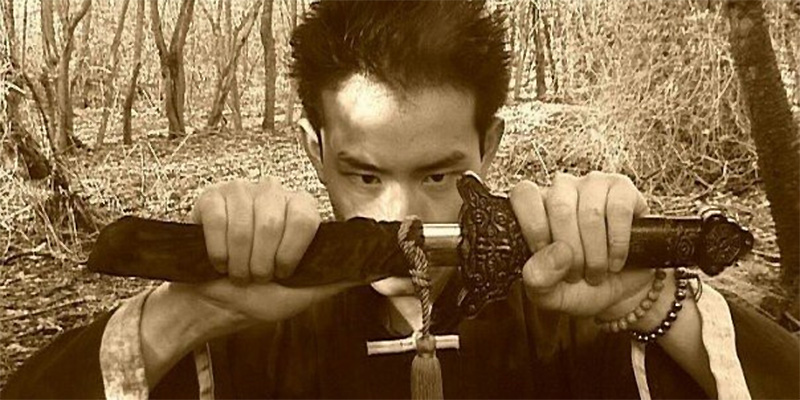
On the 27th February, 2002, Tony Ryan conducted the following interview with the Kata Hajime production team, consisting of Steve Bambury, Man Chong Li and Scott McQuaid. It was originally published in Impact magazine but slightly edited so here is the complete uncut version!
Tony Ryan: Introduce yourself and give a little insight into your backgrounds.
Steve Bambury: Well I studied film in Kent for three years and then spent most of the year 2000 developing this script called “A Path Less Travelled” which had been in my head for at least five years. It’s pretty much my Lynchian movie – I’m a huge David Lynch fan – I even read the Twin Peaks fanzine for a while! I was also a big fan of Eastern cinema, probably due to growing up with this fool for a companion (motions to Mango).
Man Chong Li: Cheers.
SB: You’re welcome. Anyway when I finished the script I couldn’t bear the thought of optioning it off to Hollywood just to let some chump mess with it so I put it in my drawer and its still there!
MCL: I was working on “Nemesis” which is a project that I’ve been developing for quite some time now. It’s an adult-themed story that I both write and draw, about a team of hitmen called Nemesis. They inhabit this world that is essentially itself a genetic hybrid of the past and the future. It incorporates a lot of classical mythology but is still clearly science fiction.
Scott Mcquaid: I’ve been carving my niche as an actor now for quite some time as well as travelling the world and honing my martial arts. I have worked as an actor both here and in Asia and I’ve studied martial arts in Japan, China, Indonesia – all over really! Though I’ve been taught many styles my focus now is the Indonesian art of Penchak Silat. It’s such a unique and powerful style but its hardly known especially in the West – my ambition is to bring it to the attention of the world through film.
TR: Why did you decide to start this company and make ‘Return to Earth‘?
SM: I’d basically always wanted to make a martial arts film as it would allow me to unite my acting ability and martial (arts) training. When I met Steve and Mangs I thought they had the drive and creativity to pull it off. I was working with Steve in a video store, we’d hung out a couple of times and I’d shown him some weapons techniques. Anyway so we started throwing the idea back and forth that we should make a movie before I headed off to the States – though I ended up going to Japan instead. I think it was putting back all those Gary Daniels features that was getting to me so much! I just knew I could do something so much better if the opportunity arose. Steve?
SB: So Mangs had just read the Rodriguez book “Rebel Without A Crew” – his account of making El Mariachi. He raved about it so I read it too and the second I finished it the single thought in my head was “go make a film”. So we did.
MCL: The opportunity was there since Scott was about so we went to work.
TR: Where did the company name come from?
SB: It’s a Japanese chokehold, a submission manoeuvre that’s illegal in judo. Anyone who watched ECW about five years ago might recognise it.
TR: If you could have had double the budget, where would it have been spent?
MCL: We would have spent at least some of it on special effects, maybe hiring a company to do post-production touch-ups. We could have improved the support system for the wirework, which while the bits that we used came off ok; it could always have been better and allowed for more possibilities.
SM: I would have liked to have been able to personalise some of the weaponry a bit. So for example if a character was gonna use a sai it doesn’t just look like some normal sai you can find in a martial arts shop – it’d have its own trademark to distinguish it and establish its bond with the character. Phil’s axe definitely was something that could’ve done with that.
SB: Just to clarify for all those of you outside of present company when we talk about “Phil” we are actually referring to Paul Wise who plays Gwai Lo in the movie. Actually if anybody could tell us why we call him Phil and not Paul we’d really appreciate it!
(laughter)
Talking of him though I would have liked more cash for the costume and makeup – particularly where Gwai Lo was concerned.
MCL: It would have been nice to have some replica weaponry to double for what we were using you know so there was less of the element of real danger – like getting hit with a real pickaxe!
SB: I think with ‘Return to Earth’ it’s fair to say that we made our few hundred pounds budget look like at least a couple of thousand. Next time round it’d be nice to actually have 4 figures plus so we can try and make it look like a couple of million!
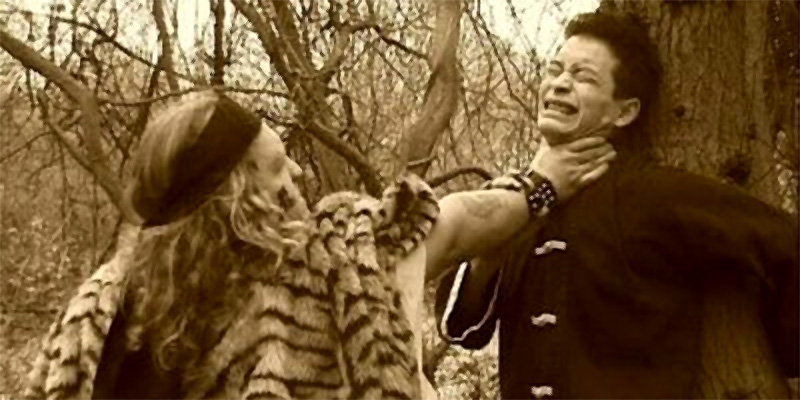
TR: What are your biggest regrets from making ‘Return to Earth’, the things you wish you could change?
SM: Shooting the bulk of the film when we did, about a year ago, proved a torturous lesson in British weather. We’re talking rain, ice-cold winds even snow during the choreo’ sessions!
SB: Then he cleared off to Japan and we were wearing shorts when we shot the slope sequence in July!
MCL: Dude you’re ruining the illusion!
SB: Oops ok yeah, so we shot the whole thing at the same time and there’s no need to look for season-based continuity errors ok?
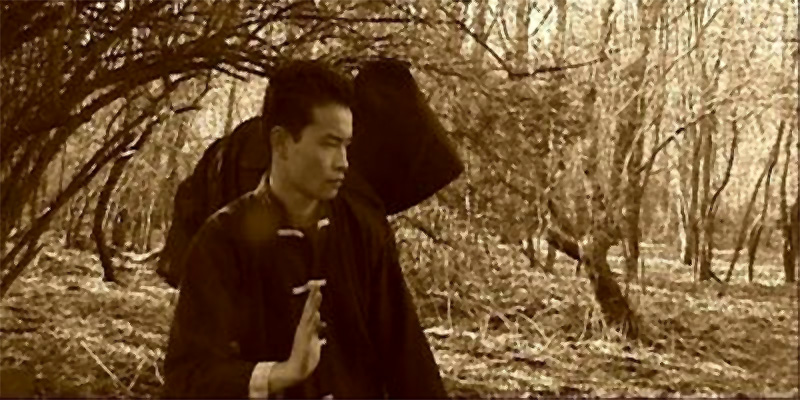
MCL: Thank god for sepia. You see it turned out that we had more time than we originally thought we did. We always knew that Scott was off to Japan from about two week after we planned to start shooting. Of course one week in and I had my little accident which through us totally off track. Then the foot and mouth crisis hit and our set was closed off! By the time we we’re able to start rolling again Scott was practically stepping back off the plane. In the end he was able to come back out for the final days of shooting. It annoys me to think that we often rushed headlong initially because we thought that we were on such a tight schedule when in reality we could have afforded to take a steadier approach.
SM: I regret having to drop the nunchaku battle between Seppuku and Gwai Lo that was in the original narrative. It was supposed to go before the sai and kama fight in the ring but was written out because I left for Japan and thought that the shoot would be all tied up whilst I was away. Like Mangs was saying, looking back it’s annoying to know that we could have kept it and shot it when I returned. It would have been nice because you don’t often see many nunchaku versus nunchaku scenes. Also I would have liked to have had some unarmed fighting to break up the weapons-based combat.
SB: Obviously on the whole our biggest regret was that deep down we knew that, as a result of Mang’s accident, we weren’t getting to make the film we set out to make and that both the plot and the choreography suffered as a result. What can I say? At the end of the day we were better off to have produced what some may consider an underdeveloped film than to have produced no film at all. We wouldn’t be here talking to you if we hadn’t rolled with the punches.
TR: From pre-production to post-production what were the biggest challenges?
SB: The biggest problem back in the beginning was getting the resources and people to enable us to pull the whole thing together with no financial backing at all. We appreciate everyone that did come on board to help us out; we couldn’t have done it without their support. Particular credit should go to Marcus Redmond who both helped out many times and was a great member of the team.
SM: The on the spot re-choreographing of the bulk of the film was the biggest challenge for me during the shoot. It was agonising to waste all that hard pre-production work. Suddenly I wasn’t working with someone close to my weight and build who was flexible and quick, it was a big dramatic change. Luckily I’d known and worked with Phil for so long that I knew both his strengths and weaknesses. We tried to save as much as possible but a lot of what had been intended would never have worked with Phil.
SB: Yeah, as far as the re-scripting went, my main concern was also the loss of ideas. I cannot stand to waste good ideas and tried to save or adapt as much of the original script as possible.
MCL: The post-production was an arduous process because there was a particular look that we wanted for the film but we had to achieve it within the parameters that the software set for us. We had to bend a lot of the rules and constantly strive to find ways to achieve the look we eventually did. Fitting the music tracks and sound effects to work in conjunction with the images was also a challenge. Essentially I crafted the entire audio soundscape from scratch. The special effects were primarily created through the manipulation of various functions such as transitions within the editing software. They helped create a mystical feel to the film and lend more gravitas to the power of the Seppuku character. Despite the limitations I think that the effects came off quite well overall.
TR: The editing is obviously so crucial to a film as a whole.
MCL: Yeah, it’s been a real treat putting the pieces together and watching the film come alive. We played the film out with the rapid-fire cuts of Hong Kong cinema; interspersed with tense, steady build-ups towards the action. It’s the combination of lulls and starts that build the strong climax – something any good film should have.
SB: Despite everything I was so happy that the end of the film is clearly the best bit! It’s a simple concept you might think but how many films are ruined by weak endings? Its the last thing the audience takes away with them, its need to be powerful and atmospheric.
MCL: The soundtrack lends so much to the atmosphere. After laying it down you could see that the film had become much more eerie and unsettling than we originally thought.
TR: What did you learn from the film with regards to the choreography of the action sequences?
SM: Things that I’ve learnt from this time round…
SB: Don’t fight Mangs?
SM: Yeah, don’t ever fight Mango – you end up owing a life debt!
(laughter)
No but it does help if you’ve got people with experience. You do need martial artists pitched against martial artists. Preparation will be the key word for the sequel.
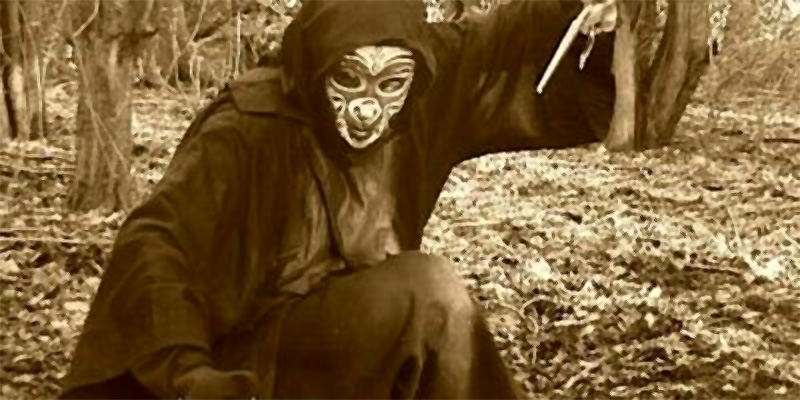
TR: How will the choreography techniques develop in the next film?
SM: The choreography should develop a hell of a lot. The fighting will be tighter and fought a lot closer since not all of it will be weapons-based. There will be a whole variety of styles on display from tae kwon do to traditional Chinese wu shu and mantis styles. It’ll provide a much bigger platform for me to demonstrate my penchak silat as well. In general the whole thing’ll be sharper, quicker and both more fluid with more acrobatics.
MCL: The way I see the development for the action in the sequel is that the fights will be completely relative to the story line of the film. The fights will actually affect the characters and how the rest of their story arcs play out. More often than not in kung fu films the characters will just fight and they don’t tend to mean anything, especially in tournament films. There is no emotional key behind the aspect of the fight, which is the direction we’re moving in. Not to give too much away, but certain things are going to happen in the narrative that will reflect in the fighters’ approach to specific combat situations.
TR: When did your passion for martial arts films begin, and how has it changed over the years?
SM: I was really young. The first actual live-action film that I ever watched was ‘Enter the Dragon‘ so that had a profound effect on me! Here was this simple but captivating story, full of mystery but charged with adrenaline and full of these amazing characters. Bruce Lee being so untouchable really shone through it all though.
SB: Come on tell the truth!
SM: Ok, it was Jim Kelly‘s microphone hairstyle that won me over.
(laughter)
Anyway since I was nine I explored many different styles and became a huge martial arts movie fanatic. Today martial arts are no longer simply a passion for me but a way of life. Everything revolves around martial arts. It’s a journey I began many years ago that has no immediate destination.
MCL: Hong Kong cinema has been around my life from very early childhood, but like most people, my interest was captured through Jackie Chan. I think ‘Half A Loaf of Kung Fu‘ was one of the first films of his that I saw. Since then, I’ve favoured films that express more technique in martial arts over, for want of a better term, “Bruce Lee fighting”. Not to take anything away from the man himself, but it’s testimony to his greatness that he’s the only one that could pull it off. I’ve also been deterred by too many cash-ins on his persona. I also feel the use of wirework has to be judicious. It should enhance the action and not have the action dependant on it. SB: I remember when Jackie Chan’s name started flying around school as someone to keep an eye on but initially it was the anime stuff that gave me a taste for the Orient. I remember seeing ‘Fist of The North Star’ and thinking it was the absolute don. The first kung fu movie I saw was probably ‘Enter the Dragon’ but then later on it was the Shaw Brothers stuff that reignited the fuse. I loved stuff like ‘Shaolin Martial Arts’ and ‘Shaolin vs. Lama‘. Again growing up with Mangs as my closest friend is probably the biggest cause for the weaving of Eastern culture through my life. At the moment I’m really into Andrew Lau‘s work especially ‘The Duel‘, I also really liked that Korean movie ‘Bichunmoo’ a lot. Still got a soft spot for ‘Moon Warriors‘ though and I adore ‘Raiders of Wu-Tang’, Sonny Yue could have been such a star if he’d actually liked making movies!
TR: Who have been your greatest influences in becoming filmmakers?
SM: My biggest influence as far as filmmaking goes would probably be Tsui Hark. He just surprises you every time with his style. Next to him, probably Tim Burton for that dark-fairytale quality he manages to inject into his subjects. Martial arts and choreo-wise it’d be Bruce Lee, Sammo Hung, Jackie Chan – in that order. Bruce for his untouchability, Sammo for the sheer amazement he creates due to both his size and ability and Jackie for his creativity.
MCL: This may seem clichéd but I would be remiss by not touching base with the work of John Woo and Jackie Chan as inspirations. Sammo Hung as well, as a martial (arts) director and performer. Robert Rodriguez for the impetus behind us all. Coming from an editor’s point of view, it’s the medium itself that really interests me, and the manipulation and application of all the footage telling the story you want to tell.
SB: Lynch, Fincher, Woo, Raimi, Smith, Hark, Lau, Linklater – the list of influences would be a long one but in the end it all comes back to one man – Robert Rodriguez. If we hadn’t read “Rebel Without A Crew” we wouldn’t have made the film, it’s that simple.
TR: Have you worked with any famous names in martial arts movies already?
SM: Whilst in Asia in 1996 I guested in the ATV series ‘King Of Gamblers’ and also appeared in TVB’s ‘Kindred Spirit’ before starring in two movies in 1997 – ‘Emergency Unit’ and then ‘Ebola Syndrome’ alongside the notorious Anthony Wong.
TR: Who would you most like to work with and why?
SB: Actors I’d like to work with? I think Andy Lau has a great face and on-screen presence, as does Ekin Cheng. Seriously though, how cool would a film with Edward Norton and Aaron Kwok be?!! The answer is very. As for behind the scenes I’d love to get Trent Reznor or Angelo Badalamenti in to put a score to a film for me.
MCL: So many people from the East I’d love to work with like Anthony Wong; he grabs your attention whatever character he’s playing, but he does the sinister and the morally ambiguous so well. Failing that, Yuen Wah, Johnny Lo or Hwang Jang Lee. Great bad guys. I’d love to pick John Woo and David Fincher’s brains.
SM: Director-wise I’d also have to say Woo; he just has this way with characterisation that I totally admire. Choreography-wise it’d have to be the main man Chan. I know I could learn so much from Jackie and it’d be a great honour to work alongside him. As for Western talent it’d be De Niro, Nicholson and Eddie Murphy for sure.
TR: What film would you make if you had no budget or time restrictions?
MCL: The Iliad, as a trilogy. Or a live action ‘Ninja Scroll’ movie.
SB: ‘Predator 3’? Actually I think that’s already being made. There are loads really – I’d love to adapt Iain Banks novel “The Wasp Factory” coz its pretty messed up and shoot a Bill Hicks biopic. Also I still think a kung fu take on the old TV series ‘Manimal’ could be sweet but it’d have to have that Andrew Lau style going on. Besides that then definitely I love to develop my ‘Path Less Travelled’ script or Mangs’ Nemesis comic – that’d be so cool as a movie!
SM: My dream would be to do a big budget, lavish take on the Monkey King story. Other than that I always thought that Bruce’s tiered combat concept from ‘Game of Death‘ could be fleshed out into something really special.
TR: What do you think of the current Hollywood trend to use Hong Kong style action? And also Hong Kong’s recent tendency to make Hollywood style films?
MCL: Hollywood’s approach to using Hong Kong style action in their films is a double-edged sword. While it’s certainly inspiring to see the influence of HK cinema grabbing the attention of tinsel town, they have a tendency to saturate the market in the mad rush for an original approach. Too often you get dime a dozen films churned out off the back of a particular success. Imitation may be the sincerest form of flattery, but if you don’t add something new, it’s just an imitation. It’s a balancing act between characterisation and action, as it always has been in any film. The right balance has to be found between Hong Kong styles within the framework of Hollywood sensibilities. Works the other way too.
SB: Pretty much sums it up.
TR: How have you been received outside of the UK?
SM: Whilst I was in Japan, Steve sent me the first few trailer cuts and they went down unbelievably over there. As a result, a release of some form over there is looking to be on the cards.
SB: On top of that we’ve had a distributor in Toronto and also one in Dubai already show interest in the film. Not bad considering we’ve not even begun to push it yet!
MCL: The original intention of the film was simply to use it almost as a practise-run before attempting something much grander. Somehow the whole project ended up escalating though and we realised that with the amount of time and hard work we’d put in it must be worth getting it out there a bit more than we first planned to.
TR: ‘Return to Earth’ certainly shows great potential, how are plans going for the sequel?
SB: It’s going really well. Whilst Mangs has been finishing up on ‘Return to Earth’ we’ve put an amazing plot together for the sequel. Imagine the intricate narrative of ‘Snatch’ or ‘Pulp Fiction’ set against a martial arts background. I’m currently writing the first draft then Mangs will come in and rewrite it to fit his directorial vision since he’s helming this one and I’ll be focusing on the producer’s job.
SM: Though I’m off to the States at the start of March I have already developed several choreography concepts and will continue to as more and more information is forwarded to me over the coming months.
TR: Can you tell us anything else about the sequel? How does it relate to the first film?
SM: The cast and crew have already been added to immensely. As I said earlier there will be a lot of different styles on display as we have a wealth of martial artists coming on board.
MCL: We also plan to shoot some of it in New York, some in Japan and some in China thanks to contacts we now have in those places. The story is very worldwide so it’d be nice to shoot in the places the scenes are set.
SB: See personally I don’t really know how much to tell you. I won’t even attempt to run through the plot because when I did that for Scott when he came back from Japan I went hoarse! Trust me, its very involved but its very, very cool. As for the relation to ‘Return to Earth’ well that’s the beauty of it. You see, the sequel will not only continue the story from the first film but it will incorporate the original story – the one that was written off after Mang’s’ accident.
MCL: There’s a scene in ‘Return to Earth’ when Seppuku is hiding in the treetops and he thinks to himself, “It was not supposed to be like this.” Lets just say that the original script represents how it was “supposed to be” and that the events of the sequel are precipitated by this break in the cycle.
SB: Look we’re getting a bit too in depth now. Let’s just say it’s got kung fu, ninja, mute swordsmen, rastafarian gangsters, torture, assassinations, possession, betrayal, honour, true love…
SM: Hey it’s starting to sound like ‘The Princess Bride’ now!
SB: Oh and we’ve got a gang of fifty bikers for it too.
TR: What else is in the Kata Hajime pipeline?
MCL: I’m going to take a break for a while over the next few weeks – months and months of editing has worn me out a bit! What that also means is that I should finally be able to return to Nemesis and hopefully get the pilot issue all sewn up by the time Steve starts passing me scenes from Shades of Myth to redraft.
SB: In the run up to the shoot for the sequel we’ve got a bunch of smaller projects that we’re working on. In the immediate future we’re gonna be shooting a music video for a talented young singer called Louise Le Gry who should herself feature in Shades of Myth and will sing in Japanese in it! After that, we’re due to shoot a video for a band called Nadir who again will be involved with Shades of Myth as they are recording some original tunes for the soundtrack. Later in the year we may work again with some of the guys from Concentration Camp, who wrote the original theme to ‘Return to Earth’. These little projects will allow us to keep our creative juices flowing and also to learn more. We are always students as there is always something new to learn.
TR: Any final comments?
SM: In film we are beginners, we walk in the land of giants, but you will see our footprints.
SB: Nice, that’s nice.
MCL: Very profound.
SM: You liked that huh?