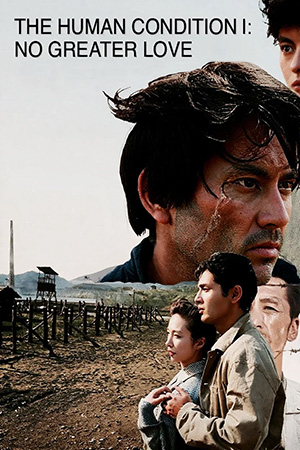
The recent death of Tatsuya Nakadai encouraged me to look into some of his most acclaimed work. This meant watching the slightly intimidating, but universally praised, ‘The Human Condition’ trilogy directed by Masaki Kobayashi. Not that the cinematic world needed a nobody like me to confirm it, but ‘The Human Condition I: No Greater Love’ is truly a staggering achievement.
Conscientious objector Kaji (Nakadai) is given the opportunity to fulfil his war-time service at an iron ore mine that uses Chinese slave labour in Manchuria. Reluctant at first, Kaji realises that the other option is imprisonment, which could well be a fate worse than death, and so takes up the role of supervisor at the mine. Kaji’s progressive ways, which focus on prisoner welfare and fairness, are at odds with his superiors who insist on using force to increase production. Nevertheless, Kaji is allowed to run things his way and gradually wins over his colleagues while forming an uneasy alliance with the Chinese. But forces within the camp, both on the Japanese and Chinese side, are focused on disrupting the peace and Kaji’s principles are soon under threat.
Clocking in at around ten hours, the full ‘The Human Condition’ trilogy is a shattering, unparalleled work of cinema. ‘No Greater Love’ starts things superbly, showing the ugliness of war and the stand that people take to survive. The story is full of people who compromise, who sell their dignity in the maelstrom, but most importantly there are characters who put their very lives on the line to do what they believe is right. It’s that third camp that shows the optimism of Kobayashi’s film even though it doesn’t conclude in a way that could be called optimistic. Quite the reverse, in fact; Kaji loses much because of his inherently righteous principles. Yet there is something powerful about showing how even in the most debased condition of existence, people can be better than their circumstances. It’s not shown in an idealistic way as Kaji is ultimately a pawn between factions and even the Chinese prisoners use him for their own ends. Nevertheless, it acts as a reminder of the dignity and power of someone making a stand.
‘No Greater Love’ is such a richly textured work with so many characters and sub-plots that one can only scratch the surface in the synopsis. Needless to say, Kaji’s story is just one part of the whole, though it is perhaps the meatiest portion. The alliances between prisoners and prison guards, the nuance among each camp, shows the complexity of this ugly situation. This is not an apologia for Japan’s involvement in the war, but Kobayashi’s grand statement about how so many different kinds of people with very different kinds of principles get sucked into the hell. As a piece of anti-war art, it is outstanding as it never idealises its characters nor makes others completely irredeemable, even though there are nefarious elements in the story.
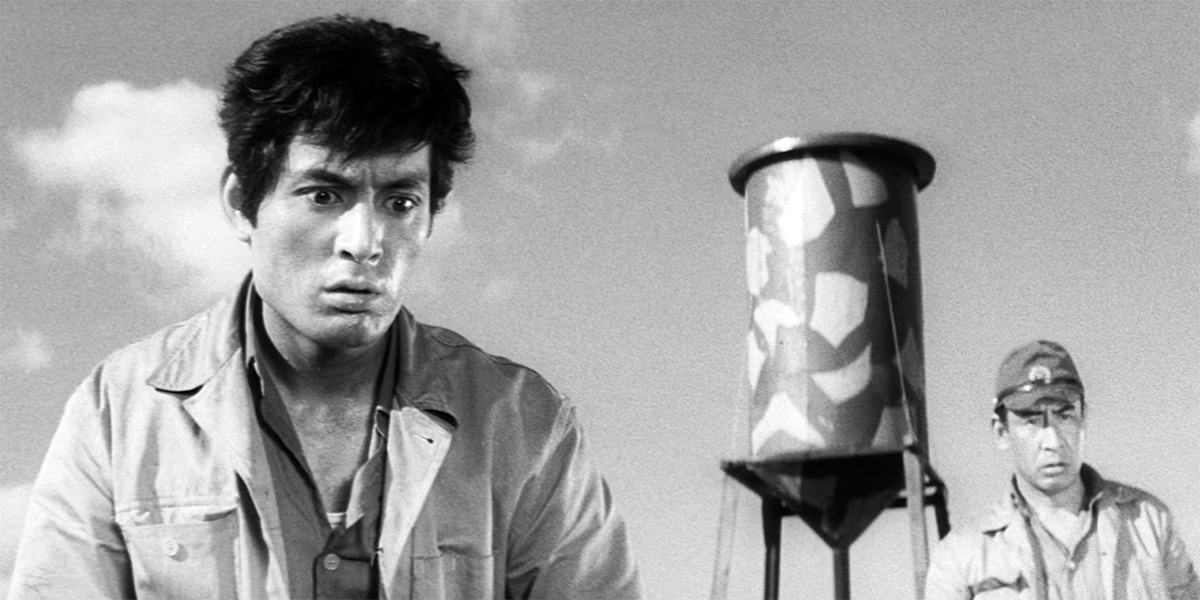
Kobayashi is aided by tremendous performances from the cast. It’s no surprise that Tatsuya Nakadai walks away with most of the plaudits; his is an exhausting, ageing role shot in what appear to be the toughest of environments. Not since I watched ‘Wages of Fear’ have I been so impressed with how people can act in such challenging circumstances. Nakadai has one of those incredible faces that shows so much and the black and white photography gives a haunting quality that I’m not sure colour could have afforded it. The cast around Nakadai is first-class too with Keiji Sada being a notable stand-out.
‘The Human Condition I: No Greater Love’ is essential viewing for cinephiles even if its length might put the casual viewer off. It’s cinema of the very highest standard, a work of exceptional insight and penetration.